Best Books on InvestingBest Books on Wealth BuildingBest Books on EconomicsBest Books on Personal Finance
Part of Best Books on Personal Finance →
Curated Reading on Money, Wealth & Economics

The best books for freelancers and side hustlers to manage their money

Employment advice assumes a salary, a payroll department, and employer-sponsored benefits — none of which apply to irregular income. These five are written for the specific mechanics of self-employment: taxes you calculate yourself, income that doesn't arrive on a schedule, and no one else building your safety net.

Curated by Capital Readers — updated monthly with the titles worth your time.
Compiled by Capital Readers Team — researched and curated from published reviews, reader consensus, and AI-assisted analysis
Rankings are researched and reviewed before publishing. How we choose books →
Last updated

Best Books for Freelancers and Side Hustlers

The 5 books built for irregular income, not a salary

For anyone earning outside a single steady paycheck — full-time freelance, a side hustle, or contract work — where the standard personal finance playbook doesn't quite apply.

Cover of The Money Book for Freelancers, Part-Timers, and the Self-Employed by Joseph D'Agnese & Denise Kiernan

The Money Book for Freelancers, Part-Timers, and the Self-Employed

by Joseph D'Agnese & Denise Kiernan · 2010

Written specifically for irregular income rather than adapted from salaried advice — covers the self-employment tax, quarterly estimated payments, and retirement accounts a W-2 employer would otherwise handle automatically. The starting point if you've never had to build these systems yourself.

Core idea
A freelancer has to manually replicate everything a payroll department does invisibly for an employee — the book is a checklist for building that missing infrastructure.
Read it if
You're new to self-employment and don't yet have a system for taxes, savings, or insurance.
Skip it if
You've been freelancing for years and already have these mechanics in place.
Buy on AmazonBookshop.orgPaperback · Kindle
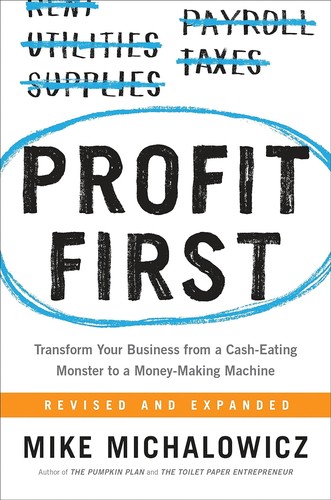
Cover of Profit First by Mike Michalowicz

Profit First

by Mike Michalowicz · 2014

A cash allocation system built for irregular income: every payment gets split across separate accounts for profit, taxes, and owner pay the moment it arrives, instead of being budgeted from a shrinking bank balance at month's end. Counterintuitive on the accounting, effective on the behaviour.

Core idea
Allocate percentages the moment money arrives, and taxes and profit stop being an afterthought you discover you can't afford.
Read it if
You've been surprised by a tax bill or an empty account despite a decent month of income.
Skip it if
You already run separate business accounts with a disciplined transfer system.
Buy on AmazonBookshop.orgHardcover · Paperback · Kindle · Audiobook

J.K. Lasser's Guide to Self-Employment

by Barbara Weltman · 2013

A reference rather than a read-through: deductions, quarterly estimated taxes, and the paperwork differences between a sole proprietorship, LLC, and S-corp, explained for someone filing without a payroll department behind them. Dense, but the density is the point.

Core idea
Most self-employment tax mistakes are missed deductions and structure choices, not fraud — both are fixable with the right checklist.
Read it if
You want the tax mechanics explained in detail, not summarized.
Skip it if
You want narrative or motivation — this is a reference book, read in sections.
Buy on AmazonBookshop.orgPaperback · Kindle
Cover of The Freelancer's Bible by Sara Horowitz & Toni Sciarra Poynter

The Freelancer's Bible

by Sara Horowitz & Toni Sciarra Poynter · 2012

Written by the founder of the Freelancers Union, and it shows: the strongest sections are on setting rates, structuring contracts, and replacing the benefits an employer would normally provide. Broader than money alone, but the money chapters are specific enough to act on.

Core idea
Rates, contracts, and benefits are decisions freelancers make once and live with for years — worth getting deliberately, not by accident.
Read it if
You want the business side of freelancing — contracts and rates — not just the accounting.
Skip it if
You already have your rate and contract templates settled.
Buy on AmazonBookshop.orgPaperback · Kindle
Cover of Company of One by Paul Jarvis

Company of One

by Paul Jarvis · 2019

The counterargument to every other book on this list: growth isn't automatically the goal, and staying intentionally small can be the more profitable, more sustainable decision for one person doing the work. A useful check before scaling becomes the default answer.

Core idea
Bigger isn't the only measure of success — sometimes the better decision is staying exactly the size you are.
Read it if
You're successful enough to be pressured toward hiring or scaling and want the counter-case first.
Skip it if
You're just starting out — this book assumes you already have a functioning freelance income.
Buy on AmazonBookshop.orgHardcover · Paperback · Kindle · Audiobook
“A salary hides a dozen decisions an employer makes for you. Self-employment means making every one of them yourself — starting with taxes.”
— Capital Readers, Editorial Note
How this list was made

Why these five, in this order

D'Agnese and Kiernan open the list because most readers arriving here have never had to build the infrastructure a payroll department normally provides invisibly — tax withholding, retirement contributions, insurance — and their book is the most direct checklist for building it. Michalowicz's cash system follows because knowing what to do and actually doing it every time you're paid are different problems. Weltman's guide sits third as the reference to open once the system is running and a specific tax question comes up. Horowitz addresses the parts of freelancing that aren't strictly financial — rates and contracts — but shape income directly enough to belong here. Jarvis closes the list deliberately: every other book on it assumes growth is the goal, and his doesn't.

How is this different from the general Personal Finance hub?

The hub covers systems that assume a regular paycheck. Everything here assumes irregular income and no employer — different tax mechanics, different cash-flow problems, a different safety net to build yourself.

Where should someone brand-new to freelancing start?

The Money Book for Freelancers, Part-Timers, and the Self-Employed, then Profit First. Together they cover the tax basics and the cash system before anything more specific matters.

Do these apply outside the United States?

The tax specifics in Lasser's guide and parts of the Money Book are US-focused. The cash-flow logic in Profit First and the business decisions in Company of One and The Freelancer's Bible travel regardless of country.

Is any of this advice, formally?

No. These are book reviews, not personalised tax or financial advice, and self-employment tax rules vary by jurisdiction and change often — confirm specifics with a professional, not a book.

More Reading Lists

View All Lists →

One list. One book. Every two weeks.

A short, opinionated email — no filler, no fifty-book roundups. Just what's worth reading next.

As an Amazon Associate and Bookshop.org affiliate, we earn from qualifying purchases.